Every time someone worries AI will shrink their industry, someone else reaches for Jevons paradox. The argument: when something gets more efficient, people don’t use less of it, they use more. Cheaper coal didn’t reduce coal consumption in the nineteenth century, it multiplied it, because it opened up uses that weren’t economical before. Apply the same logic to AI: cheaper code, cheaper analysis, cheaper decisions should mean more software gets built, more problems get worth solving, more of the work you do, not less.
It’s a real economic law, and at the level it’s pitched at, it’s usually right. It’s also answering a different question from the one most people think it’s answering.
The horse already ran this experiment
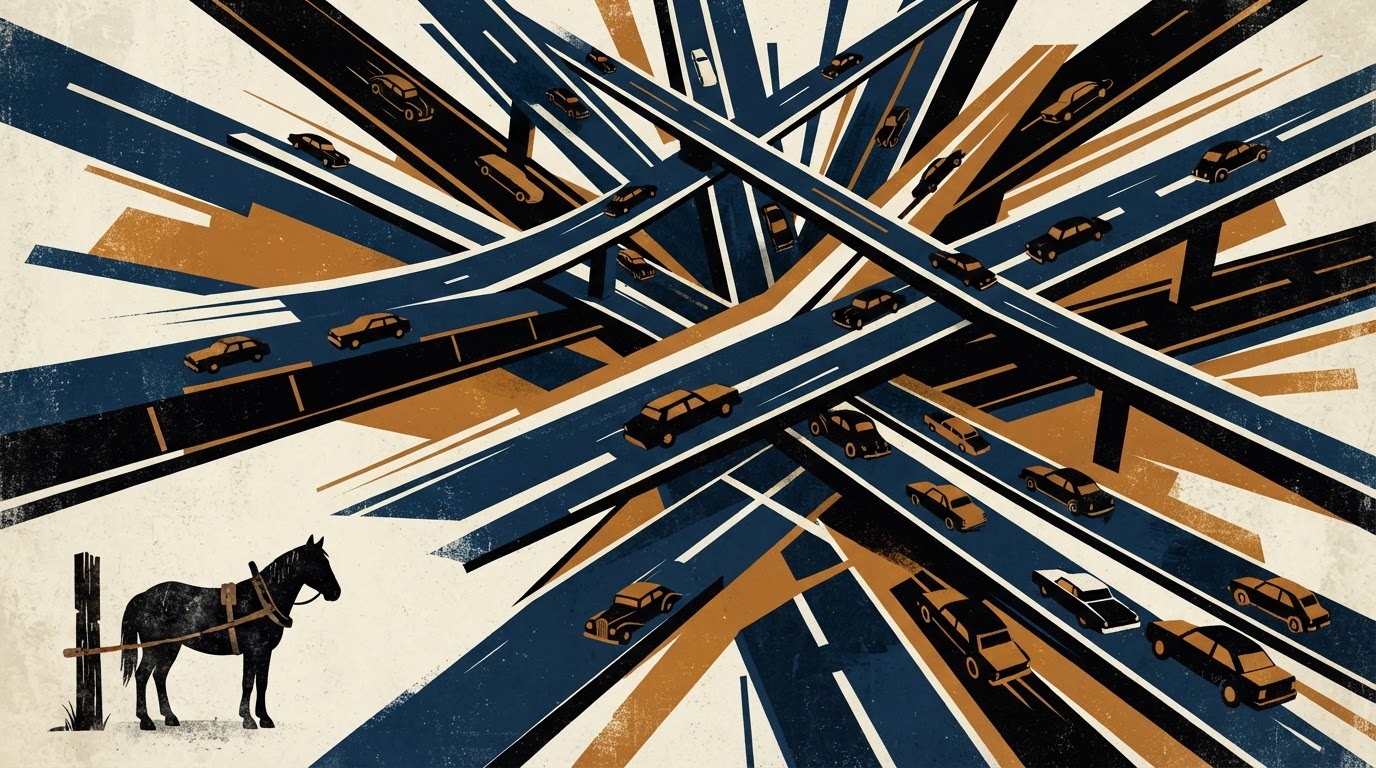
In the early twentieth century, the car arrived and did exactly what Jevons would have predicted. Transportation got dramatically cheaper and more convenient, and demand for it exploded, more trips, more distance travelled, more goods moved, a transportation economy an order of magnitude bigger than what horses alone had ever supported.
The number of working horses in the United States fell from roughly 26 million to around 3 million. Twenty-three million jobs, gone, at the exact moment the market they operated in was growing the fastest it ever had.
Jevons wasn’t wrong. Total demand for the underlying function, moving people and things, did explode. What the paradox never promised is that the horse would be the one meeting that demand. It promised the function would grow. It said nothing about which supplier of that function would still be standing once it did.
The horses that survived mostly ended up doing the one job that was left over: carrying people for sport, the only slice of the old function they could still perform once the rest had moved to an engine.
What made the difference wasn’t the size of the market
A horse cannot retrain. Whatever skill it had at pulling a cart, it kept, and that skill either stayed in demand or it didn’t. There was no version of a horse that could learn to read a dashboard, plan a delivery route, or repair an engine. It was, in the economist’s term, a fixed input, capable of exactly one thing and incapable of becoming anything else.
Coal, in the original version of the paradox, is fixed in the same way, and that’s precisely why the paradox works so cleanly there. Coal doesn’t need to learn anything to stay useful when steam engines get more efficient. It’s still just coal. The efficiency gain flows straight through to more coal burned, because the input hasn’t changed and doesn’t need to.
People aren’t coal, and that’s the part the reassuring version of the argument quietly skips. A software engineer whose entire value was translate logic into syntax, quickly is now competing with a machine that does exactly that step for a fraction of the cost. Software engineer postings are up 11% year on year while the broader job market is flat. But in the same data, roles that only translate logic into syntax are down 27% since 2023. Both statements are Jevons paradox operating correctly, at two different levels of the same industry.
The engineers who moved up into system design, into judging whether an AI-generated solution actually solves the right problem, are seeing more demand than ever. The ones who stayed at typing the syntax are competing with a tool that does their old job for free. Jevons paradox is true for the industry and false for the role, in the same sentence, and citing the industry number to reassure the person in the role is where the comfort runs out.
The question that actually matters
None of this is an argument that AI will or won’t cost jobs in aggregate. History and Jevons paradox both suggest the total market for almost anything AI touches gets bigger, not smaller. That’s the easy, mostly correct part.
Whether the market is growing isn’t what decides your own outcome inside it. I’ve argued before that the professionals who come through this fine are the ones who can move, who add a second and third dimension to whatever they were narrowly good at, rather than staying fixed at the one thing that’s about to get cheap. What actually decides your outcome is simpler than any market forecast: are you the fixed input, doing the one task at the one level a machine can now do for less, or are you the input that can still change what it does once the function it used to perform gets automated out from under it.
A horse could not answer that question differently no matter how the market for transportation grew. You can. The market growing is not the reassurance. Your own capacity to become something other than what you already are, that’s the reassurance, if there is one, and it isn’t automatic. It’s the same argument behind building a T-shaped skill set instead of a single deep specialism: breadth is what makes you an elastic input instead of a fixed one, and elastic inputs are the ones still standing when the function they serve gets nine times bigger.
Twenty-three million horses found out what happens to a fixed input in a growing market. The market grew. They didn’t.

Leave a Reply