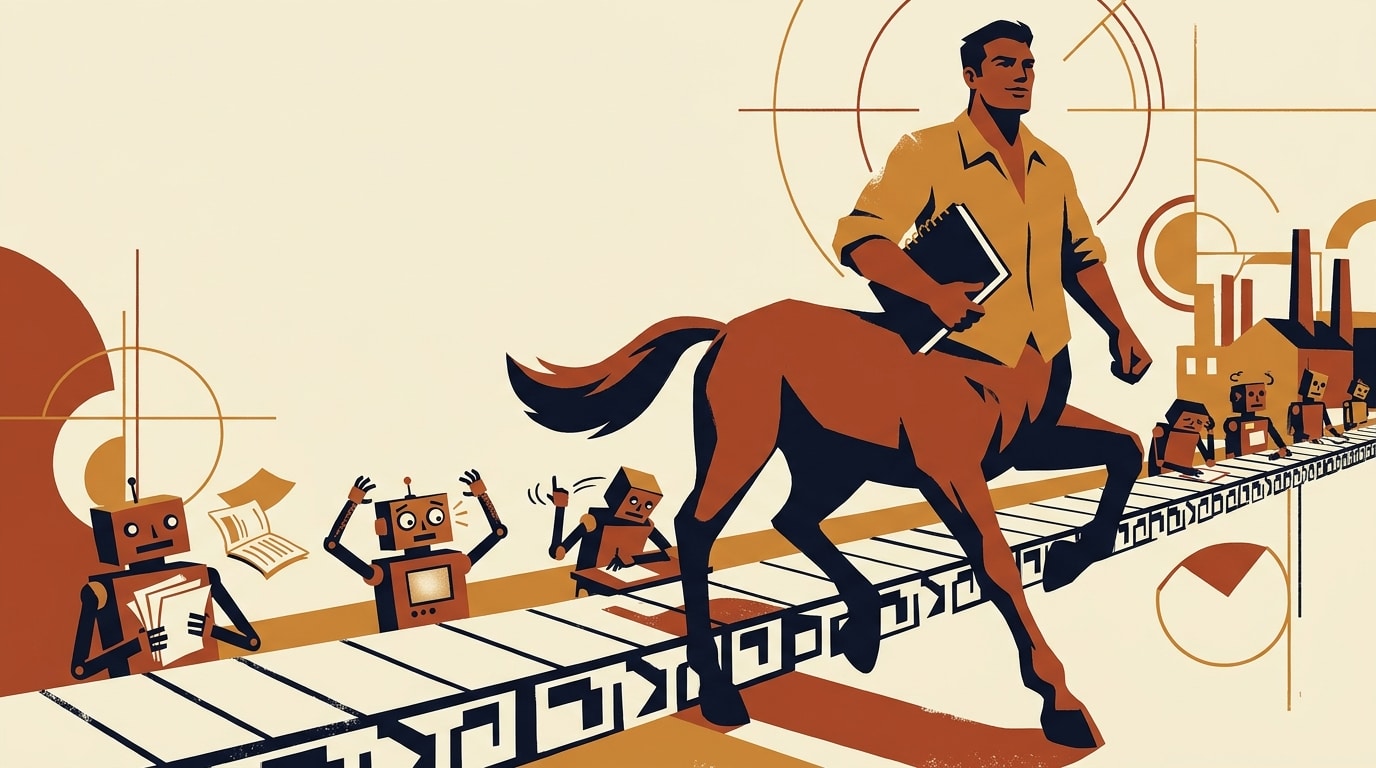
In 1911, Frederick Winslow Taylor published The Principles of Scientific Management. His argument: break any task, however complex, into its constituent movements, optimise each one, and assemble the whole into a reliable, repeatable system. Workers stop thinking. They execute.
It seemed to work. The production lines that followed transformed manufacturing and built the modern industrial economy. Taylor seemed to be on to something.
But in April 2018, Elon Musk said something that Taylor’s followers never had to: “Excessive automation at Tesla was a mistake. To be precise, my mistake. Humans are underrated.”
Musk had tried to take Taylorism to its endpoint: a fully automated Gigafactory where robots handled everything and people were the problem to engineer out. The Model 3 production line collapsed. Targets were missed by months. He reversed course publicly, called his own mistake by name, and brought people back onto the floor.
The lesson most people took from this was that automation has limits. That is the wrong lesson.
McKinsey recently proposed decomposing “cognitive work” into standardised tasks for AI agents. An intellectual assembly line. One agent handles research. Another drafts. Another reviews. The human supervises, presumably, the way a factory foreman once walked the floor.
This is Taylorism applied to thinking. Same in-built weakness, new domain.
The problem at the Gigafactory was not that automation reached its limits. Musk had misunderstood where people add value. He removed them from the parts of the process where they were slow, inconsistent and expensive. He then kept removing, until he hit the parts where they were irreplaceable. The line stopped.
Taylor made the same error in a different domain. His methods worked for the decomposable parts of physical labour. They broke on the judgment-intensive exceptions that every complex process eventually produces: work with no possible standard procedure.
Cognitive work is almost entirely those exceptions.
In May 1997, Garry Kasparov lost to Deep Blue. The following year, he proposed an experiment: what if the two played together, human and computer in real time, each doing what it does best?
The resulting format, Advanced Chess, surprised nearly everyone. Human-computer pairs (Kasparov called them centaurs) beat both grandmasters playing alone and supercomputers playing alone. The stranger finding: the best centaurs were not the strongest chess players. A weaker player with a better process for working with the machine beat a stronger one who treated the computer as a calculator.
The human’s role had changed completely. Not to calculate: the machine does that faster than any mind can. Not to recall: it holds more plays than players’ memory allows. The person’s job was direction: deciding which positions were worth exploring, recognising when the machine was chasing the wrong objective, overriding when the evaluation function missed something structural. That is not a job you can hand to a workflow.
The centaur model is not a metaphor. It is a description of what the winning configuration actually looks like.
The assembly line model treats people as coordinators: define the workflow, let the agents execute, check the output. The centaur model keeps the person as the continuous source of direction and judgment — in the loop not as a reviewer but as the part of the system that knows what good looks like.
The difference is load-bearing. In the assembly line, judgment is baked into the workflow design up front. In the centaur model, it travels with the person through every step.
Product teams know this car crash of an idea by another name. Waterfall promised the same thing: plan everything up front, execute against it. No feedback loops, judgment committed before the first line of work, the plan increasingly divorced from reality as execution proceeds. McKinsey’s proposal is waterfall for cognition.
That matters because the most valuable work is not the work with a standard procedure. It is the work where the right answer is not yet clear, where the definition of success is contested, where experience and context change what you do next. Automating a process before you have codified it is one version of this mistake. The deeper version is assuming that once you have codified it, the human’s role disappears.
It doesn’t. It shifts to a place that is harder to codify and impossible to replace.
Here is what McKinsey misses, and what Musk missed too before the Gigafactory corrected him. You cannot design a centaur. You can only grow one.
Assembly lines are engineered from above: a systems architect decides who does what, and people slot in. The centaurs in Kasparov’s experiment were not following a protocol handed down by anyone. They developed their own way of working with the machine through practice, through feedback, through learning what the computer was good at and where it needed steering. The amateurs who beat the grandmasters were not executing a better system design. They had grown a better relationship with the tool.
Every programme follows the same path. Define the workflow. Optimise the handoffs. Measure the throughput.
Then they wonder why the output feels hollow: technically correct but disconnected from the actual problem. The assembly line is humming. The judgment is nowhere.
The question is not how to decompose your cognitive processes into agent tasks. It is: where do I, specifically, add something the machine cannot? And how do I design conditions that let that relationship grow — rather than a workflow that assumes the relationship is already figured out?
Getting into the chariot is not a metaphor for stepping aside. It is a metaphor for steering.
Taylor’s insight was that people doing mechanical work could be made more productive by removing their discretion. His mistake was thinking all work was mechanical.
You can build an assembly line. You cannot build a centaur, but you can become one.

[…] You Can’t Build a Centaur made the argument that the winning configuration in human-AI systems is not the assembly line — one agent for research, one for drafting, a human to supervise — but the centaur: a person deeply enough integrated with the tool to direct it, correct it, and take the judgment calls it cannot make. The pure specialist cannot be a centaur. They have the depth in one domain but none of the breadth that makes the direction meaningful. […]