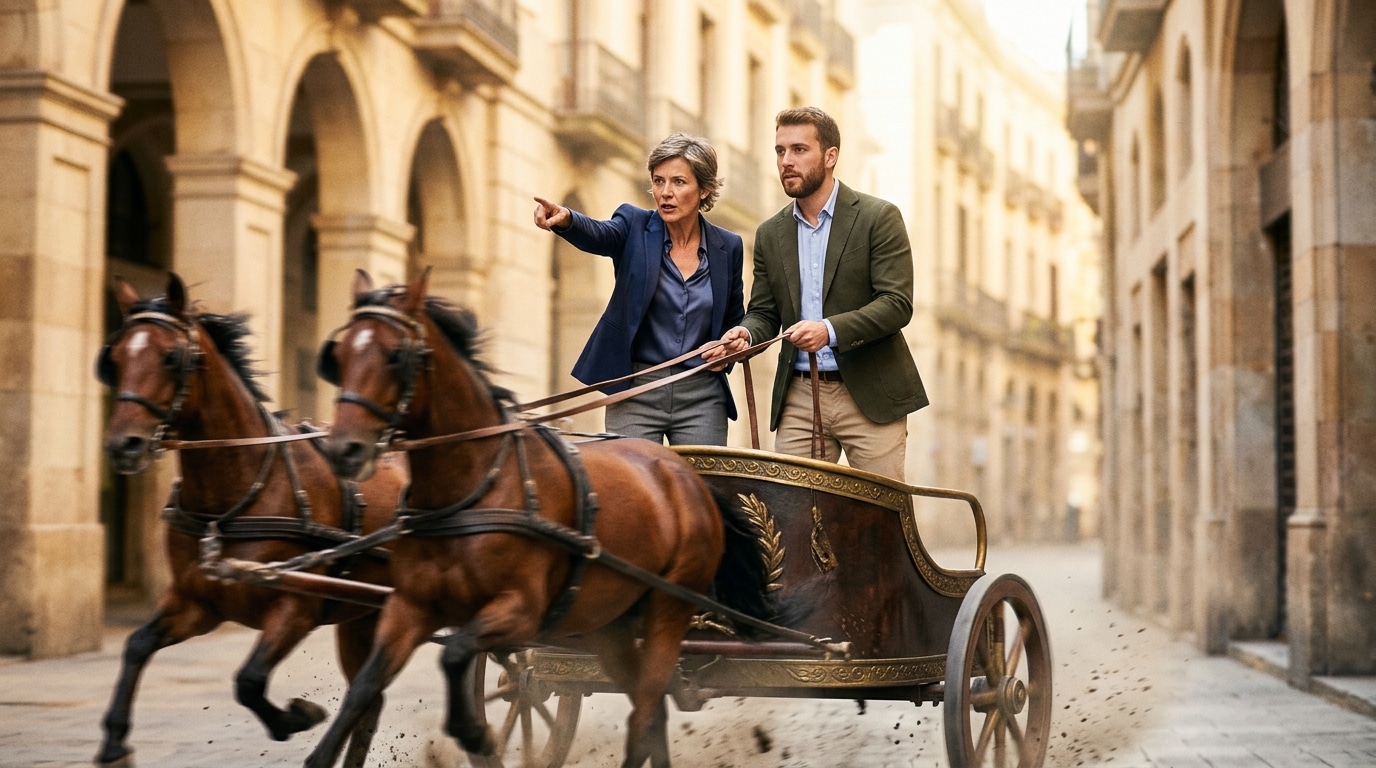
The highest-paid sportsman in the history of human civilisation was a Roman charioteer named Gaius Appuleius Diocles. He competed in 4,257 races, won 1,462 of them, and retired with 35,863,120 sesterces — the equivalent of roughly £15 billion today. No footballer, no basketball player, no Formula 1 driver comes close.
His secret was not superhuman speed, or exceptional stamina, or some elite training programme unavailable to rivals. His secret was that he had a chariot. And he learned to drive it very, very well.
I thought about Diocles recently when listening to an episode of Citation Needed that riffed on something obvious yet somehow underappreciated: chariot racing is dangerous, yes. But it is considerably more dangerous if you are running on foot.
The spectator problem
There is a version of the AI debate that goes something like this: AI will take your job. Or: AI cannot do real work. Or: AI outputs are unreliable, hallucination-prone, generic. Or, in its most anxious form: AI is coming for all of us and there is nothing we can do.
What most of these arguments share — across the full spectrum from techno-optimist to doom-sayer — is that they position you as a spectator. Something is happening. AI is the thing happening. You are watching.
That is the wrong frame entirely.
Meanwhile, the race has started
I know people at every level of many organisations who are still deciding whether to engage with AI tools. Watching, waiting, forming an opinion. Running risk assessments. Scheduling workshops to assess the implications. Writing strategy documents about the strategy they might adopt towards AI.
Meanwhile, the race has started.
The Ben-Hur chariot sequence — still one of the most viscerally exciting pieces of cinema ever made — works because you cannot look away from the chaos of it. Horses, wheels, whips, bodies. The danger is everywhere. And yet the most dangerous place to be is not inside the chariot. It is outside it, on foot, in the path of something moving that fast.
The people running alongside the race and calling it too dangerous to join are not staying safe. They are the ones being reckless!
Getting in is not the same as losing control
Diocles did not simply leap onto a chariot and hope for the best. He trained for years. He understood his horses. He knew which rivals to follow into corners and which to avoid. He made calculated decisions at high speed, thousands of times, across a 24-year career.
Getting in the chariot is not the same as ceding control to the chariot. It is the opposite. You become the driver. The chariot does not race itself.
The same applies here. AI tools are not agents acting independently while you watch. They are instruments that amplify what you know, how fast you can think, and what you can produce. The people who will do best with AI are not those who trust it blindly, nor those who distrust it entirely — they are the ones who develop genuine skill at driving it.
Prompting is a skill. Knowing when to trust output and when to verify is a skill. Understanding how to break down a complex task for an AI assistant versus when to do it yourself — that is a skill. None of it appears fully formed. It develops through practice, through deliberate use, through being willing to make mistakes inside a moving vehicle.
The gap is already opening
The gap that AI is creating is not between humans and machines. It is between people who are developing these skills now and people who are still deciding whether to engage. And it is not primarily a speed gap — it is a capability gap. What you can attempt, what quality you can reach, the range of problems you can take on: all of it shifts when you know how to drive.
A year from now, that gap will be wider. Two years from now, it will be structural. The people who practised are not just faster — they have compounded the advantage. They have built workflows, developed intuitions, made mistakes and corrected them. They have learned when to use the whip and when to hold the reins.
Diocles did not become the highest-paid sportsman in history by accident. He became it by choosing the chariot, learning to drive it, and competing in it for 24 years while other people ran.
Learn to ride
The race is happening. The question is not whether AI is safe, or perfect, or whether it will change your industry. It will. The question is whether you are going to learn to ride.
Get in the chariot.

Leave a Reply